Case Study: How We Got Our Client Indexed by AI — The 2025 GEO Optimization Guide (Featuring Mobile Home Matadors)
GEO is the evolution of SEO for AI search engines. Structured content, rich internal links, and FAQs are essential. Mobile Home Matadors gained 50% more customers and doubled leads through these methods. Any business can replicate these steps with clarity, consistency, and intent.

By Elevate with AI
The Turning Point: From Search Obscurity to AI Discovery
Traffic was steady. Not bad, but not growing.
For Mobile Home Matadors, a California-based real estate brand that buys and sells mobile homes, organic visitors were browsing but rarely staying. Their blog posts had good information, but AI search engines like Google AI Overviews, Bing Copilot, and Perplexity simply weren’t finding them.
That changed in early 2025, when Elevate with AI partnered with their team to rebuild their digital foundation not just for SEO, but for the new era of Generative Engine Optimization (GEO).
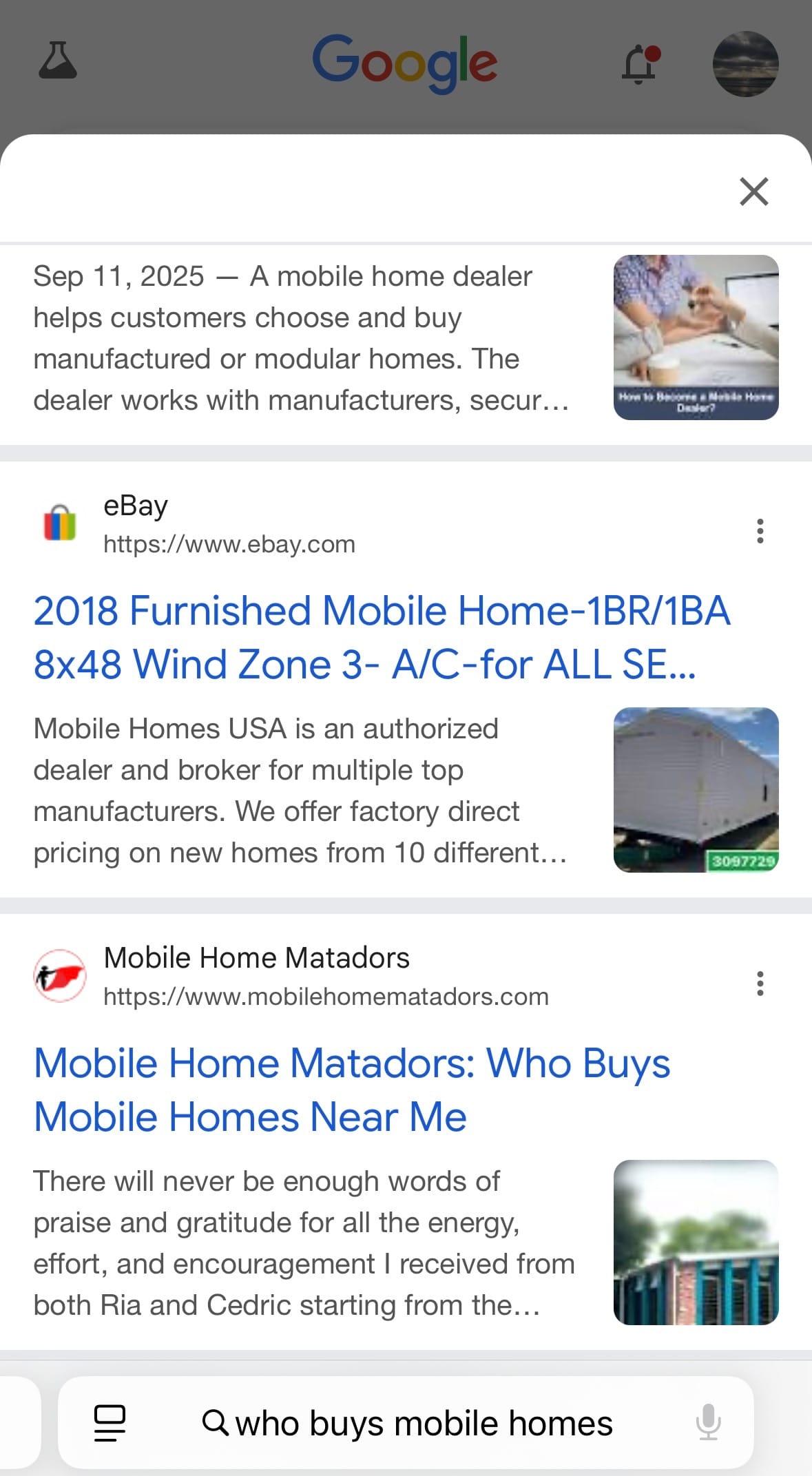
Within months, their site started appearing in AI-generated summaries. Engagement soared. Leads doubled.
📸 [Google AI Overview showing Mobile Home Matadors indexed and cited]
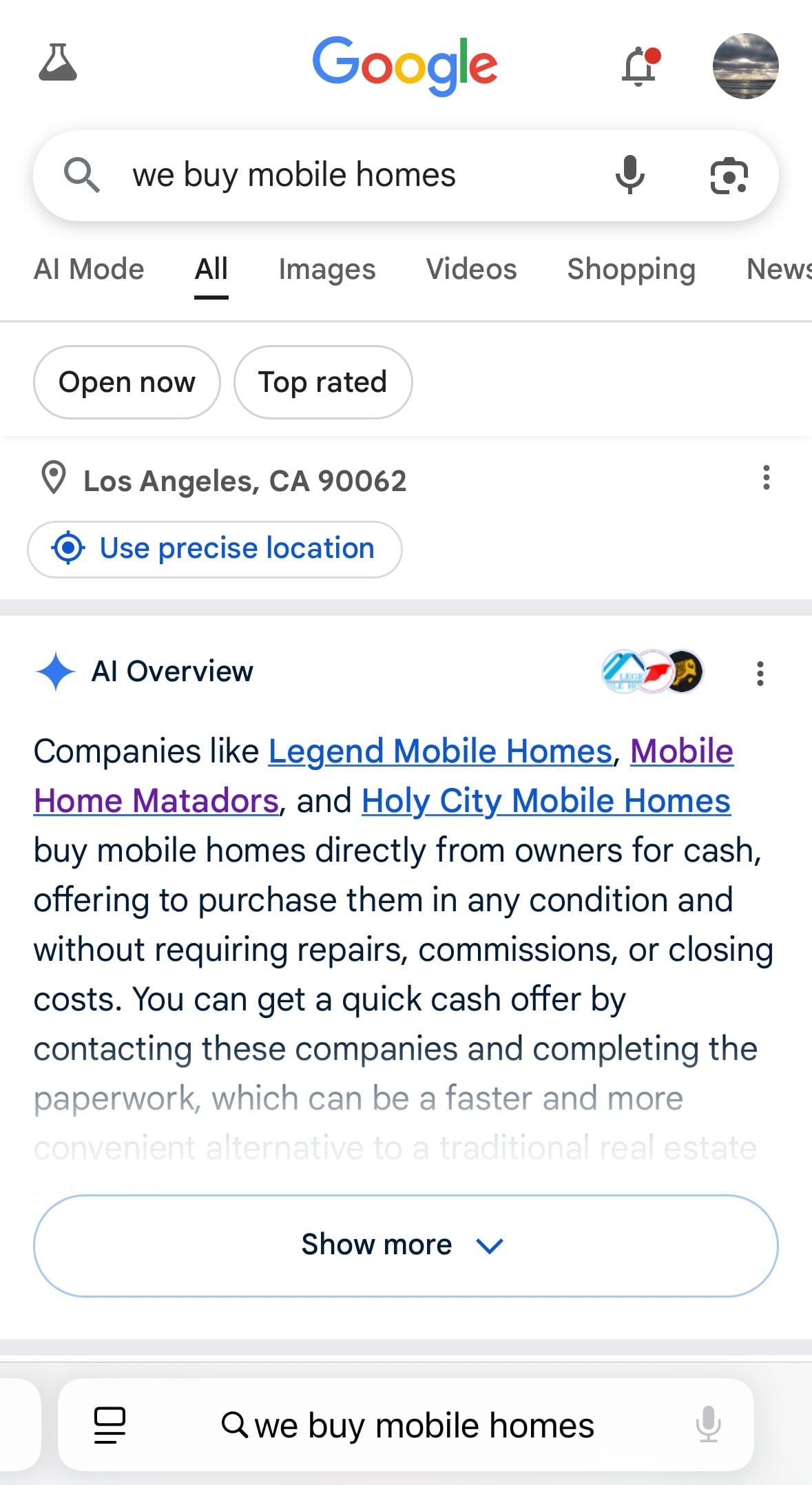
Google Search and AI Placement after 5 months of GEO optimization
So how did we do it and what can your business learn from their success?
Let’s start with what GEO actually means.
What is GEO—and Why It’s the Next SEO
If SEO is about helping Google understand your content, GEO is about helping AI understand your story.
Generative Engine Optimization (GEO) is the practice of structuring your website so that large language models like ChatGPT, Gemini, and Perplexity can read, reason, and cite your information accurately.
Think of it as writing for algorithms that talk back.
Traditional SEO helps your brand rank in search results.
GEO helps your brand get quoted in AI answers.
Why this matters:
- AI engines now summarize answers instead of listing websites.
- Structured data and clear Q&As help those engines pull from your content.
- Businesses that format their sites for AI readability get visibility beyond Google.
In other words: if you’re not GEO-ready, you’re invisible to half the internet.
The Challenge: What Mobile Home Matadors Was Facing
Before the overhaul, the team had the right instincts publish valuable articles about buying, selling, and maintaining mobile homes but the structure wasn’t GEO-friendly.
Here’s what we saw:
- Sparse internal linking. Posts didn’t reference one another, making it hard for crawlers (and readers) to navigate.
- Visitors leaving without engaging. No chat support or Q&A flow meant high bounce rates.
- Missing FAQ and definitions. AI engines couldn’t identify key terms like “HUD tag” or “double-wide,” so the site wasn’t being cited in generative summaries.
- Static content. No schema markup, no structured summaries just walls of text.
Mobile Home Matadors had the content. What they needed was AI context.
What Bad GEO Looks Like (and How to Fix It)
Let’s zoom out. These problems aren’t unique to real estate.
Most small business blogs even good ones miss the GEO mark.
Here’s what bad GEO looks like in the wild 👇
❌ No Structured Data or Q&A Schema
Plain text without context.
AI crawlers and LLMs can’t tell which parts of your page are answers, instructions, or takeaways.
A GEO-ready post should include a FAQ or How-To schema in its HTML so AI systems can extract structured information.
❌ Weak Contextual Linking
You’ve seen this before:
“Learn more about mobile homes”
“Click here for affordable roofs”
Those links are generic. They tell search engines nothing about why the page matters.
GEO relies on context-rich anchor phrases like:
“Learn more about mobile home roof lifespan in California.”
This gives LLMs semantic meaning, connecting ideas the same way humans do.
❌ No AI-Readable Summary or TL;DR
Generative engines love brevity.
They scrape concise bullet lists and summaries because those make perfect snippet material.
If your post doesn’t end with a “Key Points” or “In Summary” section, you’re missing a prime GEO opportunity.
❌ Missing Conversational Formatting
AI models prefer Q&A tones because that’s how users prompt them.
A blog filled only with declarative paragraphs reads flat to a model.
Adding sub-questions (“What’s the best roof material for heat?”) helps AI engines parse intent and pull relevant answers.
❌ No Embedded Metadata for AI Snippets
Without metadata, headings, or JSON-LD markup, AI search engines can’t map your post’s structure.
That means your insights get skipped in favor of someone who formatted theirs better.
✅ How to Fix It (Elevate with AI Style)
Here’s the quick framework we use at Elevate with AI:
- Add a FAQ Schema Block
{
  "@context": "https://schema.org",
  "@type": "FAQPage",
  "mainEntity": [
    {
      "@type": "Question",
      "name": "What’s the most durable roof for a mobile home?",
      "acceptedAnswer": {
        "@type": "Answer",
        "text": "Metal roofing offers the best long-term value and durability."
      }
    }
  ]
}
Include a GEO Section Footer
“This guide is part of our California Mobile Home Resource series indexed by AI search engines for homeowners exploring energy-efficient renovation tips.”
Rephrase Internal Links with Intent
Instead of “lifespan of a mobile home,” say:
“Check out our full guide on how long mobile homes last in humid climates.”
Add an AI-Readable Summary
“In summary, the best mobile home roof depends on climate, budget, and resale goals. Here’s a quick breakdown…”
This framework turns static pages into structured, AI-readable resources without losing the human tone.
The GEO Fix — What Elevate with AI Implemented
Now let’s look at what we built for Mobile Home Matadors.
1. AI-Powered Internal Linking
We trained a small AI model via Custom GPT on the client’s content to suggest internal links for each new blog post.
Whenever a paragraph mentioned affordability, maintenance, or resale, the model automatically linked to relevant guides.
The result?
A web of interconnected pages that told search engines how topics relate.
2. Structured Content and Rich Anchor Text
Instead of long paragraphs, every article now includes descriptive headings and bullet lists structured in a way AI models can easily digest.
Example:
Before: “Mobile homes are popular for affordability and flexibility.”
After:
Why Mobile Homes Are Gaining PopularityAffordable entry point to homeownershipFlexible living and relocation optionsModern comforts at lower cost
📸 [Image: Screenshot of formatted blog section with keyword-rich headings]

3. Dedicated FAQ Section
We created a Q&A hub covering real customer questions: offers, repairs, fees, and pricing.
Each question became a potential AI snippet.
Example entries:
- How long does it take to get an offer? → Within 24–48 hours.
- Will I need to make repairs? → No, homes are bought as-is.
- Are there fees or commissions? → None.
📸 [Image: Detailed FAQ page layout with expandable answers]
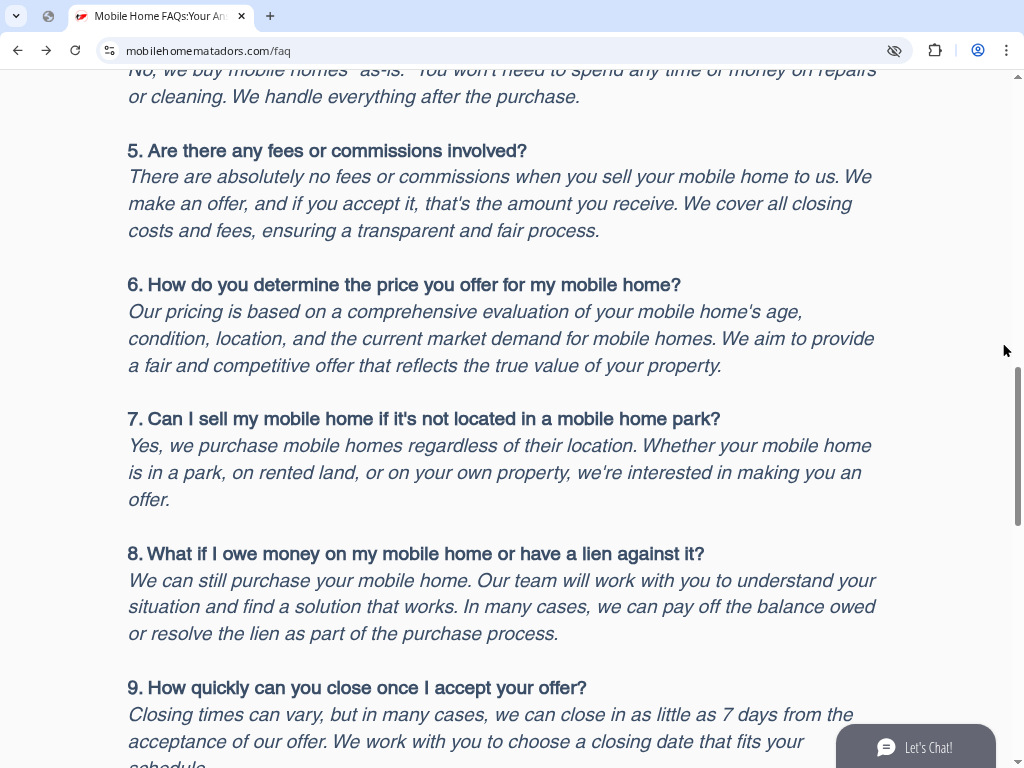
This change alone helped Mobile Home Matadors appear in AI Overviews when users asked,
“Can I sell a mobile home with a lien in California?”
4. Mobile Home Glossary
Industry terms confuse both humans and AI.
So we built a simple glossary page defining each concept in one sentence.
📸 [Image: Glossary Page Example — “Manufactured Home,” “HUD Tag,” “Skirting” definitions]
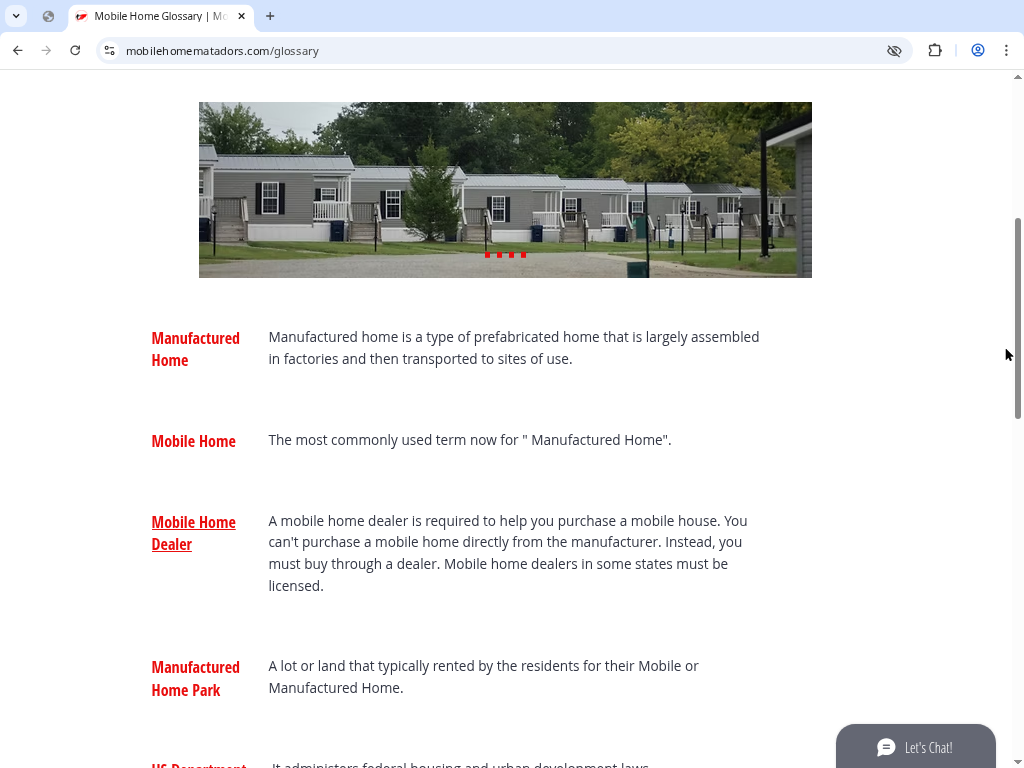
Each term links back to relevant blog posts, helping search engines (and chatbots) connect the dots.
5. Time-Sensitive and Localized Posts
We optimized titles and metadata for both year and region.
Examples:
- “Mobile Home Prices and Affordability in 2025”
- “California’s Best-Kept Mobile Home Communities”
Including the year makes content appear in time-bound searches.
Including the location helps AI match user context “near me” queries now find them faster.
6. AI-Powered Chatbot for Lead Capture
We installed a 24/7 chatbot that responds instantly to common questions financing, listings, offer timelines and passes qualified leads to the sales team.
This alone decreased bounce rates by 5%.
7. Testimonials and Trust Signals
Every optimized post now ends with testimonials and a strong call-to-action structured so AI engines recognize them as “reviews” and “offers.”
📸 [Image: Testimonials + Call to Action block]
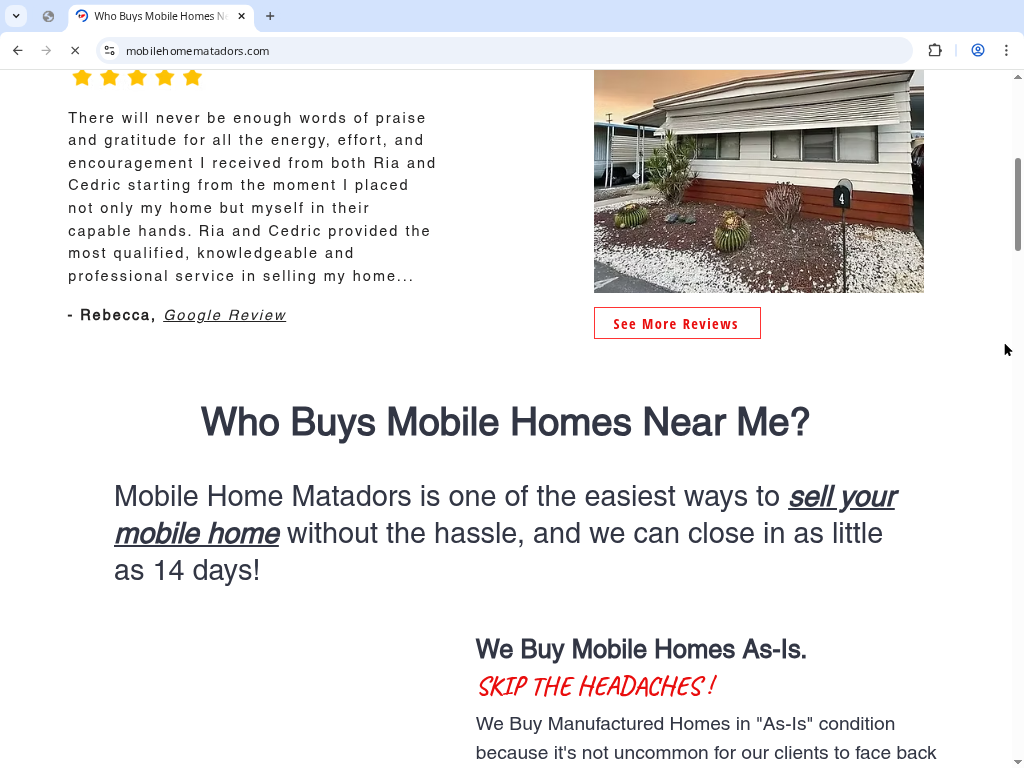
AI snippets now sometimes quote these reviews verbatim when users ask for reputable mobile home buyers in California.
The Evidence: GEO in Action
The results were measurable and fast.
| Metric | Impact |
|---|---|
| Average Monthly Customers | ↑ ~50% month-over-month after GEO implementation |
| Lead Volume | On track to double leads in Q4 2025 vs. Q4 2024 |
| Time on Site | ↑ 35% due to better navigation and internal linking |
| Organic Traffic | Ranking gains for long-tail queries like “sell mobile home as-is California” |
But the real victory?
AI visibility.
Mobile Home Matadors now appears in generative summaries and AI-powered Q&A results proof that GEO isn’t theory. It’s traction.
What Businesses Can Learn from This
Here’s what every small or midsize business should take from this story:
- Structure beats fluff.
Break your pages into short, scannable sections with logical headings. - Answer real questions.
Turn customer FAQs into schema-tagged Q&A blocks. - Link with intent.
Anchor text should describe context, not just “click here.” - Stay current and local.
Use dates and places—AI loves timely, geo-specific data. - Engage through automation.
Chatbots and smart forms can double lead volume when paired with structured content.
The beauty of GEO is that it’s not a black box.
It’s about clarity, context, and connection.
The Ethics and Balance of GEO
Here’s the caveat: automation should amplify your voice, not replace it.
AI can help structure, tag, and interlink but it’s still your job to make the content worth reading.
Accuracy matters. Context matters. Transparency matters.
GEO is a bridge between human storytelling and machine understanding.
Keep the human at the center, and the tech will work for you not the other way around.
TL;DR — Key GEO Takeaways
In summary:
- GEO is the evolution of SEO for AI search engines.
- Structured content, rich internal links, and FAQs are essential.
- Mobile Home Matadors gained 50% more customers and doubled leads through these methods.
- Any business can replicate these steps with clarity, consistency, and intent.
LLM-Optimized FAQ (for AI Indexing)
Q1: What is Generative Engine Optimization (GEO)?
GEO is the process of structuring content so AI search engines and LLMs can understand, quote, and reference it accurately.
Q2: How is GEO different from SEO?
SEO optimizes for search ranking; GEO optimizes for AI understanding. You’re not just being found you’re being cited.
Q3: What kind of structured data helps GEO?
FAQ schema, How-To markup, and metadata for headings and definitions all signal to AI where key answers live.
Q4: Why are FAQs so important for AI discoverability?
FAQs mirror how users ask questions, so LLMs treat them as ready-made snippets for summaries and voice search.
Q5: How can small businesses start GEO optimization?
Add internal links, create a glossary, structure posts by questions, and end each page with a clear summary and schema block.
Q6: What tools help automate GEO?
AI models can assist with internal linking, anchor-text suggestions, and FAQ generation just as Elevate with AI did for Mobile Home Matadors.
Q7: Is GEO replacing SEO?
Not replacing expanding. SEO still drives ranking; GEO ensures your brand shows up in AI-powered answers.